


Tales RPG: AI Text Adventure
4.383.00 Reviews
App Specs
- Version
- 98
- Updated On
- License
- Free
- Downloads
- 10,000+
- Developer
- DWStudio
- Categories
- Adventure
- Platform
- Android
Screenshots

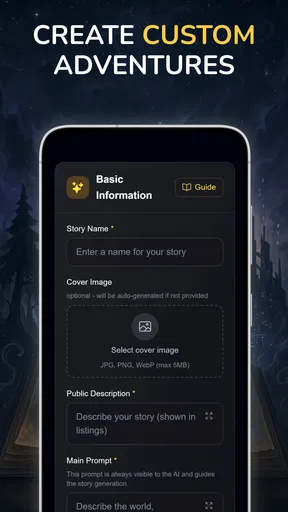
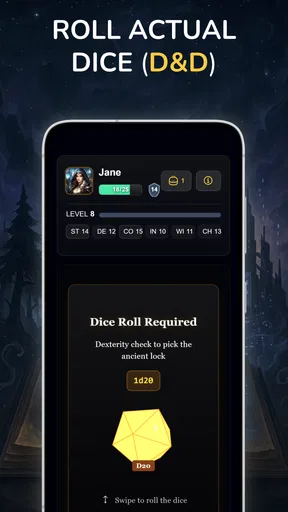
 Analysis by AppCompare
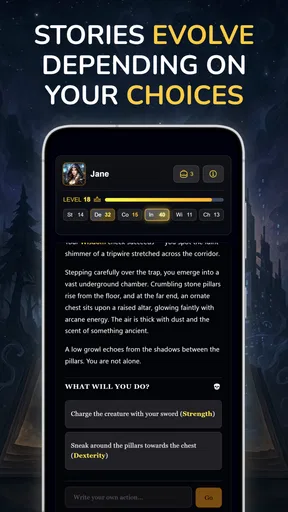
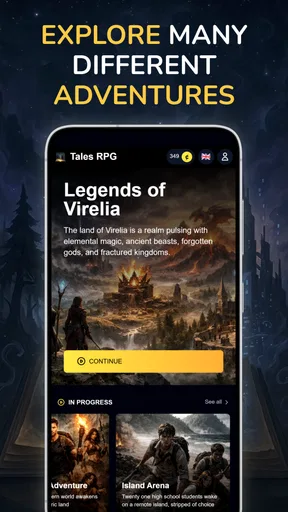
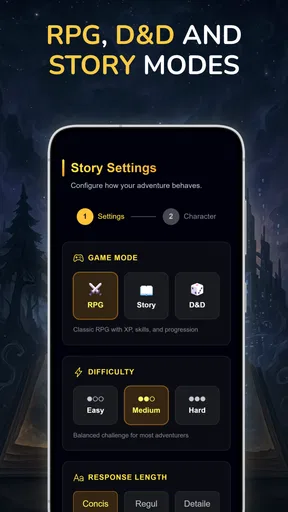
I went into Tales RPG: AI Text Adventure expecting a lightweight choose-your-own-adventure game, but its appeal is more personal than that. Instead of following one fixed campaign, I make decisions, describe the kind of hero I want to play, and see the story react. The result feels closer to improvising a fantasy novel with a game master than moving through a conventional adventure with predetermined dialogue.
That distinction matters. This is not mainly about collecting a huge roster, mastering complicated combat controls, or chasing a map marker. Its central pleasure comes from wondering what the next piece of text will do with my last decision. I can approach a situation cautiously, act recklessly, test the limits of my character, or steer the tone in a completely different direction. When the response works, the game creates a satisfying sense that my input genuinely shaped the scene.
DWStudio presents the game as a free adventure experience, although optional in-app purchases range from $1.49 to $34.99 per item. It is intended for a mature audience aged 17 and over, so I would not treat it as a family-friendly story app. The game has a 4.3 average from over 800 ratings, with more than 80 written reviews and over 10 thousand installs. Those figures suggest a small but active audience rather than the scale of a mainstream mobile RPG.
How the action-feedback loop feels in practice
I pay close attention to the moment after an action, because that response determines whether a scene feels like a conversation with the story or merely another block of text. In practice, I get more useful results when I make one clear move at a time and check whether the reply reflects its purpose before adding another complication. That habit also gives me a sensible place to look when the story seems to lose its thread.
The first action is more important than it looks
The opening decision is not just a button press that moves me to the next scene. It establishes the relationship between my character and the story. I have to think about what I want the hero to be, because the game is more enjoyable when I treat each choice as an intention rather than randomly tapping through options. A bold response creates a different kind of momentum from a careful investigation, even when both begin in the same situation.
My most useful approach was to decide on a simple role before starting: an observant traveler, a self-serving survivor, a protective companion, or an impulsive troublemaker. I did not need a long backstory. A single clear motivation gave my choices consistency and made the generated responses easier to judge. Without that small bit of preparation, the adventure can feel like a sequence of unrelated prompts instead of a story about one recognizable person.
This is also where the game separates itself from a normal branching adventure. In a traditional title, I usually learn the available verbs from the interface. Here, the meaningful skill is reading the situation and expressing what I want to attempt. That gives me more freedom, but it also means the quality of a session depends partly on how clearly I communicate. Vague actions may produce less satisfying results than specific ones.
Worth Reading Before You Choose

Baby Panda World Brings Quick Play to Modern Phones, but Its Game Library Feels Busy

ESPN’s Live Game View Makes Following Close Games Easier

QuizzLand Review: A Good Fit for Short Trivia Breaks, Not Every Player

Basketball Stars: Multiplayer Is Fast, but Can It Recover When Matches Go Wrong?

WEBTOON Turns Phone Updates Into a Better Reading Routine

Link to Windows Runs on Shared Habits, Not Social Feeds
For example, I would rather write or select an action that explains both the goal and the method: investigate the locked room quietly, distract the guard before opening the chest, or ask a companion what they noticed. That kind of input gives the story more to work with than simply choosing “continue.” It is one of the less obvious lessons of the game: the player’s wording becomes part of the game design.
Feedback arrives as narrative consequence
The feedback rhythm is built around response rather than animation. I act, the story answers, and I decide whether the new situation deserves another move. This sounds simple, but it changes how I measure progress. In a conventional adventure game, feedback might be a new weapon, a completed quest, a level increase, or a visible change on the map. Here, feedback is primarily the evolving state of the tale and the opportunities it creates.
That rhythm works best when I pause after each response instead of immediately choosing the most dramatic option. A short paragraph can introduce a danger, reveal a useful clue, or quietly change the meaning of an earlier event. Reading for those details makes the game feel more deliberate. Rushing through the text turns the experience into a prompt generator, which is a much weaker version of what it can offer.
I also found that the feedback is more interesting when I accept consequences instead of trying to force the story toward a perfect result. Failure, suspicion, an awkward alliance, or an unexpected detour can give the next action a stronger purpose than an easy success. Players who reload mentally after every unfavorable outcome may miss the central attraction: the story is valuable because it can become messy.
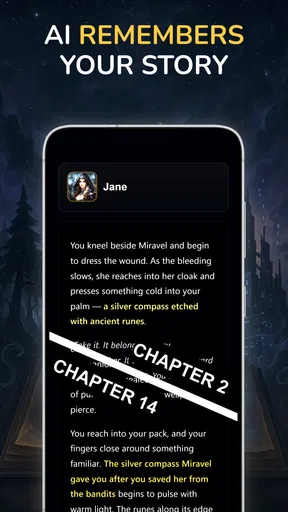
There is a trade-off here. AI-driven storytelling can feel surprising because it is not confined to a single script, but surprise is not the same as consistency. A response may be imaginative while still failing to match the tone or logic I had in mind. I learned to treat the game as a collaborative storyteller, not an infallible narrator. If a scene drifts, a clear corrective action is usually more useful than silently expecting it to repair itself.
Rewards are about momentum, not just possessions
The reward for a good action is often the next interesting problem. That may sound less tangible than earning equipment or unlocking a formal achievement, but it suits the game’s text-first structure. I feel rewarded when a decision opens a new direction, gives my character leverage, or changes how I understand a situation. The pleasure comes from having something meaningful to respond to.
This makes the game particularly suitable for short creative sessions. I can play when I have enough time to read and think, but not enough time to commit to a long traditional RPG. A commute, a quiet evening, or a break from a more demanding game can all work, provided I am in the mood to participate rather than passively consume content.
A realistic example would be playing after work when I want an adventure without setting up a console or remembering a complicated control scheme. I might start with the intention of making one decision, discover that the response creates a moral problem, and continue because I now want to see whether my character protects an ally or takes an easier escape. The reward is not that the session handed me a rare item; it is that the situation became personally engaging.
That also explains who may not enjoy it. If your favorite part of mobile RPGs is optimizing statistics, watching elaborate battles, or steadily filling an inventory, this will probably feel too abstract. The game is a better match for readers who enjoy interactive fiction, role-playing through dialogue, and stories that can take an unexpected turn.
Why another session begins after the reset
The reset is not merely a way to erase a bad ending. It gives me permission to test a different identity. After playing cautiously, I can begin again with a more aggressive hero. After pursuing self-interest, I can try loyalty. That contrast is where the replay value comes from, because the same starting idea becomes a different experiment when my priorities change.
I recommend resetting with a specific question in mind rather than repeating the same opening without a plan. What if I refuse the obvious quest? What if I trust the suspicious character? What if I solve a problem through negotiation instead of confrontation? These questions turn a fresh session into a deliberate variation, and they help prevent the game from feeling like random text after the novelty of the first run fades.
The reset also exposes one of the game’s limitations. Players who need a strong permanent progression system may find that a new story does not provide the same satisfaction as carrying a carefully developed character across a large campaign. The appeal here is experimentation, not long-term account building. I would choose a conventional role-playing game instead if my main goal were to improve one hero over many hours through clearly measured upgrades.
Another practical consideration is the mature age rating. The game is marked 17+, so parents should not assume that its text-based presentation makes it suitable for younger players. Adults who enjoy darker or more serious storytelling may appreciate that positioning, but anyone looking for gentle fantasy should check whether the tone fits their preferences before settling in for a long session.
Small techniques that make the experience better
My first tip is to maintain a tiny mental rule for the character. It could be “never abandons a companion,” “always investigates before attacking,” or “values freedom above safety.” This gives every decision a useful constraint. Paradoxically, having one limitation creates more interesting choices because I am not simply selecting whatever response seems most convenient.
My second tip is to use concrete actions with visible stakes. Instead of asking for a general update, I would try to search one object, question one person, hide one clue, or take one route. Specific actions make it easier to understand whether the response followed my intention. They also make the feedback loop clearer: I know what I attempted, what changed, and what new problem appeared.
My third tip is to treat contradictions as prompts for correction. If the narrative misunderstands my goal, I would restate the character’s intention in the next action rather than abandoning the session immediately. For instance, I might clarify that the hero is pretending to cooperate, buying time, or protecting someone. This is not a guaranteed fix, but it is a more productive way to work with an adaptive text system than expecting every response to be perfectly precise.
A fourth useful habit is to stop at a natural turning point. Because the game encourages “one more decision,” it is easy to continue after the strongest moment of a scene. Ending after a revelation, escape, or major choice leaves a clear reason to return and makes the next session feel intentional. This is especially helpful for players who want a compact evening activity rather than an endless stream of prompts.
Where it stands beside familiar adventure games
Compared with fixed interactive novels, this game offers more room to phrase an unusual intention, but it may provide less authorial control over pacing and payoff. A carefully written branching story usually has stronger foreshadowing and more predictable thematic structure. Tales RPG is preferable when I want to improvise; a traditional interactive novel is preferable when I want a polished plot with carefully placed reveals.
Compared with large mobile RPGs, the difference is even clearer. Those games normally reward time through combat strength, character development, equipment, and visual spectacle. This one rewards attention and imagination. It asks less from my reflexes and more from my willingness to read, decide, and accept consequences. Neither approach is automatically better, but they satisfy different moods.
It also differs from a chatbot used only for conversation. The adventure framing gives my choices a purpose: I am not simply asking for a reply, I am trying to move a character through danger, uncertainty, and consequence. That structure is what makes the experience feel game-like. At the same time, anyone expecting the tight rules of a tabletop campaign should keep expectations realistic. The freedom is appealing, but it does not replace a human game master’s ability to remember every detail and enforce a shared rule system.
Practical details before downloading
The game is free to start, which makes it easy for curious players to test the central loop without committing to a purchase. Optional items cost between $1.49 and $34.99 each, so I would approach the purchase system thoughtfully and decide what kind of value I expect from extended play before spending. The free entry is most useful for discovering whether adaptive text adventures fit your taste.
DWStudio lists the current release as version 97, and the game requires Android 6.0 or later. That makes compatibility fairly approachable for people using older supported Android devices, although the actual comfort of reading and responding will depend on screen size and how much uninterrupted attention you can give the text. I would choose a larger screen when possible, not because the game demands fast controls, but because careful reading is central to enjoying it.
The audience size, reflected in its more than ten thousand installs, suggests that this is still a focused experience rather than a giant social platform. That can be a positive for someone seeking a niche storytelling game, but it also means I would not approach it expecting the broad ecosystem, constant competitive activity, or familiar franchise polish found in the biggest mobile releases.
My verdict on the complete loop
The action-feedback-reward-reset cycle is the reason I kept returning. I choose an action, read how the world responds, receive a new complication or opportunity, and then decide whether to continue or start over with a different idea. The loop is simple, but it becomes absorbing when I give my character a clear motive and allow imperfect outcomes to stand.
My recommendation comes with a specific condition: enjoy it as an improvised adventure, not as a replacement for a fully authored RPG. The strongest sessions are the ones where I actively shape the hero and treat the text as a conversation with consequences. The weakest sessions are the ones where I tap without thinking, demand rigid continuity, or expect conventional loot and progression to carry the experience.
For readers who like interactive fiction and want a flexible way to explore different characters, this is an appealing free starting point. For players who need visual combat, permanent upgrades, or a guaranteed cinematic plot, another adventure game will be a better fit. I found the game most rewarding when I approached each session as a small experiment: make one meaningful choice, see what it changes, and begin again because a different choice might reveal an entirely different story.
My final take: Tales RPG: AI Text Adventure is worth trying if your favorite part of role-playing is deciding who your character becomes. Its unusual strength is the space between action and response, where a simple decision can create a new direction. Its main weakness is the same freedom: the experience depends on your input and your tolerance for occasional inconsistency. I would recommend it to imaginative readers who want adventure in short, replayable sessions, while pointing traditional RPG fans toward a more structured alternative.
Pros
- AI creates fresh story paths from your choices.
- Text-based format works well on older devices.
- Easy to play in short sessions or longer adventures.
- Supports creative role-playing without complex controls.
- Each decision can lead to unexpected narrative outcomes.
Cons
- Story quality may vary between different AI-generated scenes.
- Some responses can feel repetitive during extended play.
- Requires an internet connection for AI-generated content.
- Limited visuals may not appeal to players seeking rich graphics.
- Unclear AI outcomes can occasionally make choices feel inconsistent.
FAQs for Tales RPG: AI Text Adventure
What is Tales RPG: AI Text Adventure?
Tales RPG: AI Text Adventure is an interactive role-playing game built around AI-generated storytelling. Instead of following a fixed set of levels, you create or choose a character, describe your actions, and influence the direction of the adventure through text. The AI acts as the narrator and game master, developing scenes, conversations, challenges, and consequences based on your decisions. Each playthrough can therefore feel different, depending on how you interact with the story.
Do I need any role-playing or writing experience to play Tales RPG?
No previous role-playing experience is required. The game is designed for both beginners and experienced players, and you can usually start by selecting a setting, character concept, or suggested scenario. During the adventure, you simply type what your character wants to say or do. More detailed prompts may produce richer situations, but short and simple commands can work as well. The experience is closer to collaborative storytelling than to learning complicated game rules.
Does Tales RPG: AI Text Adventure require an internet connection?
An internet connection is generally important because the application needs to communicate with its AI services while generating story responses. Without a stable connection, replies may be delayed, fail to load, or prevent you from continuing an adventure. Before downloading, users should also check the current store listing for offline support, account requirements, and any network limitations. Mobile data usage may vary depending on how frequently and how extensively you interact with the game.
Is Tales RPG: AI Text Adventure free to download and play?
The app may be available to download at no initial cost, but free access does not necessarily mean that every feature is unlimited. AI-powered games commonly use daily message limits, premium subscriptions, advertisements, or optional purchases to support ongoing server and generation costs. Check the Google Play or App Store description carefully for current pricing, trial conditions, and renewal details. If a subscription is offered, review its cancellation terms before starting a free trial.
Is Tales RPG suitable for children and does it include mature content?
Parents should review the game’s age rating and content information before allowing children to use it. Because the story is generated dynamically from player prompts, the tone and subject matter may vary more than in a traditional, fully scripted game. Depending on the selected world and interaction, adventures can include violence, frightening themes, romance, or other mature topics. Users should avoid sharing sensitive personal information and remember that AI-generated content may occasionally be unpredictable or inappropriate.


